|
[EDIT:
“non-self-executing”
changed to “not self-executing”
to
reflect the exact language of Declaration (1).]
Greetings
Judge Thomas Buergenthal:
I just now returned from the Law Library on the campus of the
University of Washington in Seattle, Washington State, USA.
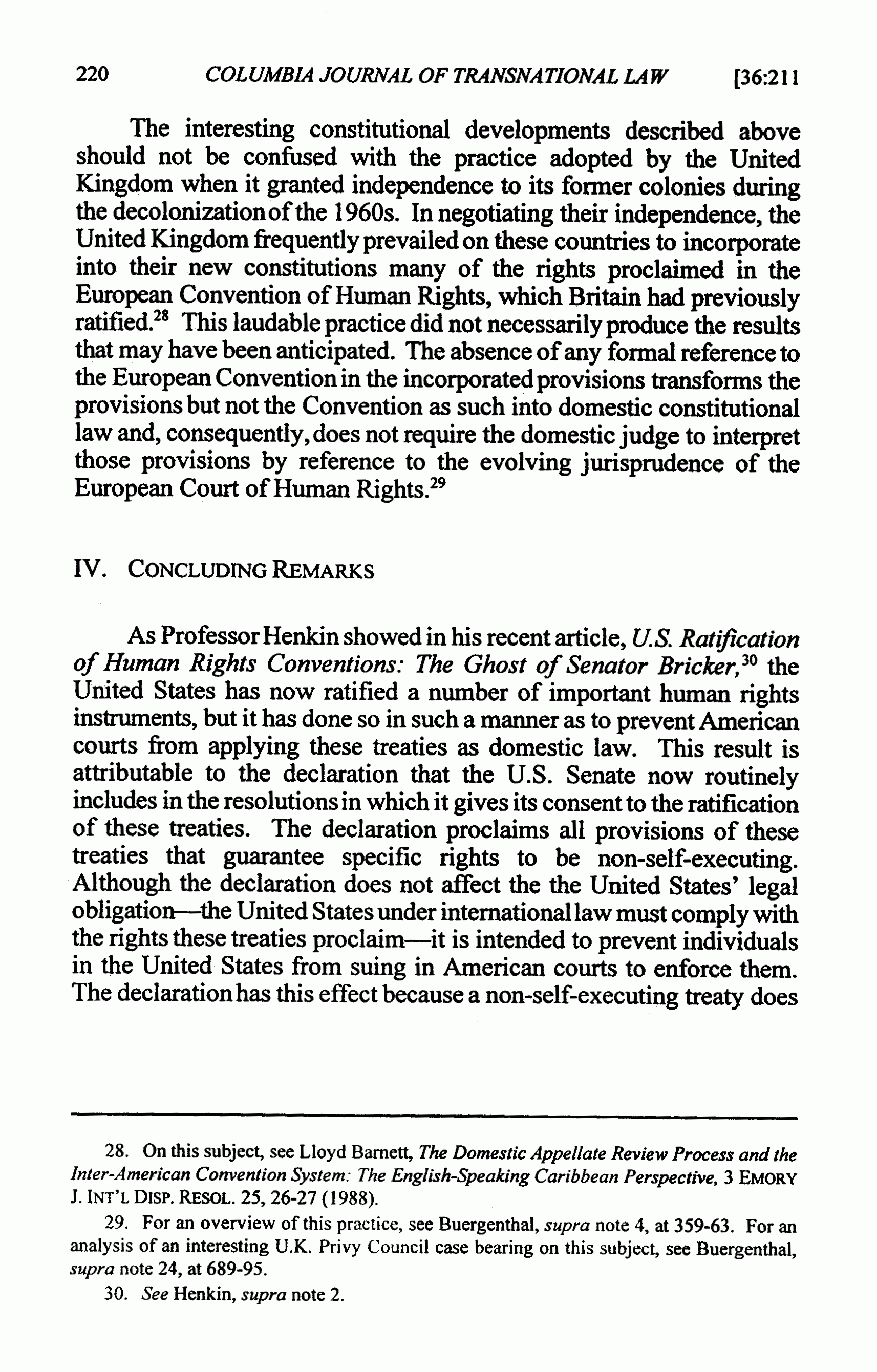
I was initially attracted to your published works on the ICCPR,
chiefly because of your Concluding Remarks in 1998,
as published in the Columbia Journal of Transnational Law
concerning Understanding (5) in the United States' Reservations,
Understandings and Declarations ("RUD"):
http://www.supremelaw.org/ref/treaty/reservations.htm
Declarations:
"(1)
That the United States declares that
the provisions of articles 1 through 27
of the Covenant are not self-executing.
I have taken the liberty of scanning your Concluding Remarks
and posting them here on the Internet, by way of exercising
a right to "fair use" of your written works:
http://www.supremelaw.org/authors/buergenthal/
... and, as you so eloquently put it, hopefully by way of
"enriching the emerging body of international law on the
subject".
I must say, it was quite an adventure to analyze other Law Review
sources which are cited by you and by other authors
who have attempted to focus on the legal force and effect
of the RUD supra (if any).
Allow me to suggest what I consider to be a very powerful
and frequently overlooked set of relevant authorities which,
in my professional opinion, settle the controversy once and for all.
Although the authors I reviewed this morning do make a
point of discussing freedom of speech in the context of the
First Amendment to the Constitution for the United States of
America, I was awe-struck by what appears to be a near total
omission of any mention of the Petition Clause in this same context.
Using your lucid logic to drive this point home, you and
other authors I reviewed today appear to agree
that the
"non-self-executing" provision in RUD Declaration (1) was
intended
"to prevent individuals from suing in American courts
to enforce" rights guaranteed by the Covenant.
In this context, whether or not it too has the force and effect of
American law, the Senate's "Proviso" is also very relevant
in this same context, to wit:
"Nothing in this Covenant requires or authorizes legislation,
or other action, by the United States of America prohibited
by the Constitution of the United States as interpreted by
the United States."
Now, I ask you: What
legislation does the First Amendment prohibit?
That "Proviso" was my touchstone, and primary motivation,
to direct your immediate attention to the standing decisions
of State and Federal Supreme Courts in America which have
carefully and thoroughly deliberated the correct meaning of the
Petition Clause in the First Amendment.
Allow me to cite and quote just a few exemplary decisions of this kind:
http://www.leagle.com/xmlResult.aspx?page=3&xmldoc=19831816710F2d1106_11638.xml&docbase=CSLWAR1-1950-1985&SizeDisp=7
As the United States Supreme Court has held, the right to petition for
redress of grievances is "among the most precious of the liberties
safeguarded by the bill of rights." See United Mineworkers of America,
District 12 v. Illinois State Bar Association,389
U.S. 217, 88 S.Ct. 353, 356, 19 L.Ed.2d 426
(1967). Inseparable from the guaranteed rights entrenched in the first
amendment, the right to petition for redress of grievances
occupies a "preferred place" in our system of representative
government, and enjoys a "sanctity and a sanction not permitting
dubious intrusions." Thomas v. Collins, 323
U.S. 516, 65 S.Ct. 315, 322, 89 L.Ed. 430 (1945).
Indeed, "[i]t was not by accident or
coincidence that that rights to freedom in speech and press were coupled in
a single guarantee with the rights of the people peaceably to assemble and
to petition for redress of grievances." Id. at 323. Moreover, the
Supreme Court has held expressly that the first amendment right to petition
protects the individuals
right to file an action with a "reasonable basis" in a state
tribunal. Bill Johnson's Restaurants, Inc. v. NLRB, ___ U.S. ___, ___, 103 S.Ct. 2161, 2169, 76 L.Ed.2d 277 (1983).6
http://caselaw.lp.findlaw.com/scripts/getcase.pl?court=US&vol=207&invol=142
The right to sue and defend in the courts is the alternative of force.
In an organized society it is the right conservative of all other
rights, and lies at the foundation of orderly government. It is one
of the highest and most essential privileges of citizenship, and must be
allowed by each state to the citizens of all other states to the precise
extent that it is allowed to its own citizens. Equality of treatment in
this respect is not left to depend upon comity between the states, but is
granted and protected by the Federal Constitution.
http://law.justia.com/cases/california/cal3d/31/527.html
These authorities make it clear that the right of petition protects
attempts to obtain redress through the institution of judicial proceedings
as well as through importuning executive officials and the [31 Cal. 3d 534]
Legislature. fn.
4 It is equally apparent that the right encompasses the act of
filing a lawsuit solely to obtain monetary compensation for individualized
wrongs, as well as filing suit to draw attention to issues of broader
public interest or political significance. As the Supreme Court
declared in Mine Workers v. Illinois Bar Assn., supra, 389
U.S. 217, 223 [19 L.Ed.2d 426, 431], "[T]he First Amendment does
not protect speech and assembly only to the extent it can be characterized
as political." (See also Thomas v. Collins, supra, 323
U.S. 516, 531 [89 L.Ed. 430, 440].) [1c] Hence, the
act of filing suit against a governmental entity represents an exercise of
the right of petition and thus invokes constitutional protection. ...
The right of petition is of parallel importance to the right of free speech
and the other overlapping, cognate rights contained in the First Amendment
and in equivalent provisions of the California Constitution. Although it
has seldom been independently analyzed, it does contain an inherent meaning
and scope distinct from the right of free speech. It is essential to
protect the ability of those who perceive themselves to be aggrieved by the
activities of governmental authorities to seek redress through all the
channels of government. A tort action against a municipality is but one of
the available means of seeking redress.
I am sure that, with all of the extensive talent and legal resources at
your
ready disposal, you will have no difficulties confirming the standing
and the wisdom necessarily intended by such language as a
"sanctity and a sanction not permitting dubious intrusions"
of any kind.
It is not difficult to substantiate empirical proof,
from the few Law Review
articles I read today, that the "not self-executing" intent of
RUD Declaration (1)
is undeniably "dubious" at best!
Accordingly, on the basis of that well developed constitutional
jurisprudence
in America, I now feel it is quite easy to conclude, if for no other
reason, that
the "not self-executing" provision in Declaration (1) of the U.S.
RUD
directly contradicts the Petition Clause in the First Amendment and,
as such, it also directly contradicts the Senate's "Proviso"
for the
very same reason:
Insofar as RUD Declaration (1) attempts to prevent individuals in the
USA
from suing in American courts to enforce rights guaranteed by the ICCPR,
it is therein a flagrantly dubious intrusion upon the Petition Clause
--
as that Clause was previously adjudicated by the U.S. Supreme Court and
by State Supreme Courts which have concurred with our high Court
on this key point.
"The Congress shall make no such Law!"
"The Executive shall enforce no such Law!!"
"The Judiciary shall uphold no such Law!!!"
Quod erat demonstrandum!
Thank you very much for your continuing consideration.
--
Sincerely yours,
/s/ Paul Andrew Mitchell, B.A., M.S.
Private Attorney General, 18 U.S.C. 1964
http://www.supremelaw.org/decs/agency/private.attorney.general.htm
http://www.supremelaw.org/reading.list.htm
http://www.supremelaw.org/index.htm
(Home Page)
http://www.supremelaw.org/support.policy.htm
(Support Policy)
http://www.supremelaw.org/guidelines.htm
(Client Guidelines)
http://www.supremelaw.org/support.guidelines.htm
(Policy + Guidelines)
All Rights Reserved without Prejudice
----------
Forwarded message ----------
From: Paul Andrew Mitchell <supremelawfirm@gmail.com>
Date: Wed, May 2, 2012 at 2:34 PM
Subject: Please Forward to Judge Thomas Buergenthal:
"The U.S. ICCPR Reservations, Understandings and Declarations Are
Self-Executing,"
by Paul Andrew Mitchell, B.A., M.S., Private Attorney General (18 USC 1964)
To: information@icj-cij.org
Please Forward to Judge Thomas Buergenthal:
http://www.icj-cij.org/court/?p1=1&p2=2&p3=1&judge=11
Thank you very much.
Bcc: clients
----------
Forwarded message ----------
From: Paul Andrew Mitchell <supremelawfirm@gmail.com>
Date: Wed, May 2, 2012 at 9:21 AM
Subject: "The U.S. ICCPR Reservations, Understandings and Declarations
Are Self-Executing," by Paul Andrew Mitchell, B.A., M.S., Private
Attorney General (18 USC 1964)
To: aseibert@mpil.de
http://www.mpil.de/ww/en/pub/organization/scientific_staff/aseibert.cfm
Greetings Dr. Seibert-Fohr,
In the United States Reservations, Understandings and Declarations
("RUD")
which it attached when ratifying the International Covenant on Civil and
Political Rights,
you have already written well on the meaning of Declaration (1):
http://www.mpil.de/shared/data/pdf/pdfmpunyb/seibert_fohr_5.pdf
(see Pages 443-453)
http://www.supremelaw.org/ref/treaty/covenant.htm
http://www.supremelaw.org/ref/treaty/reservations.htm
Declarations:
"(1) That the United States
declares that
the provisions of articles 1 through 27
of the Covenant are not self-executing.
Please note well that those RUD do not impose the same limitation
upon themselves: in other words, the RUD are excluded
from the
list of Covenant articles which are "not self-executing" in the
USA.
With that construction in mind -- call it a strict construction, for
the moment --
we can move on to Understanding (5), which states:
(5) That the United States understands that this
Covenant shall be implemented by the Federal Government to the
extent that it exercises legislative and judicial jurisdiction over the
matters covered therein, and otherwise by
the state and local governments; to
the extent that state and local governments exercise jurisdiction over such
matters, the Federal Government shall take measures appropriate
to the Federal system to the end that the competent
authorities of the state or local governments may take appropriate measures
for the fulfillment of the Covenant.
Let us then focus, in particular, on the effect of the latter 2 RUD
provisions
upon state and local governments in the USA.
Clearly, Understanding (5) in the RUD can and should be construed to
read as follows:
"This Covenant shall be implemented ... by state and local
governments; and,
to the extent that state and local governments exercise jurisdiction over
such matters ...
competent authorities of the state and local governments
may take appropriate measures for the fulfillment of the Covenant."
The latter construction is justified for several important reasons:
First, and of greatest importance in the USA, U.S. Treaties are
elevated to the
status of supreme Law of the Land by virtue of the Supremacy Clause
in the Constitution for the United States of America: that Clause expressly
identifies the Constitution, Laws and Treaties of the
United States
as supreme Law of the Land throughout America.
Second, we have just demonstrated that the Reservations,
Understandings
and Declarations are self-executing chiefly because they expressly
identify
articles 1 thru 27 in the ICCPR as "not self-executing"; however, that
limitation is
not expressly applied to the RUD as such, nor to any other Articles
of the ICCPR.
Third, insofar as the RUD are to be accorded the status of a United
States Treaty,
they can and should be regarded as a lawful implementation measure
with the
same legal force and effect as the Constitution and Laws of
the United States.
Fourth, in American constitutional law, there is a rule of
construction
which necessarily bears on the legal interpretation of the RUD:
inclusio unius
est exclusio alterius. As
such, the omission of any mention
of the RUD in Declaration (1) must be inferred as an intentional Act
of the
U.S. Senate and President when ratifying same.
Fifth, using inverse logic, Declaration (1) must be given
legal force and effect
if the United States is allowed to treat articles 1 thru 27 as "not
self-executing".
This is the only way to avoid accusations of vagueness and/or double-talk.
Cf. void
for vagueness doctrine.
Sixth, it is customary in U.S. jurisprudence to apply the term
"shall" as a
mandatory, imperative term, and to apply the term "may" as
a
discretionary, optional term in all such legislation: accordingly,
we are thereby entitled to construct the RUD reasonably as follows:
The Covenant shall be implemented by state and local
governments; and,
competent authorities of state and local governments may take
appropriate measures for fulfillment of the Covenant.
I take liberty to speak for many American lawyers, litigants and activists
when I say that all of us would be grateful for any Comments
you may have on the implementation of the ICCPR in the USA,
as we have justified it above.
Thank you, once again, for your brilliant writings on human rights in general.
--
Sincerely yours,
/s/ Paul Andrew Mitchell, B.A., M.S.
Private Attorney General, 18 U.S.C. 1964
http://www.supremelaw.org/decs/agency/private.attorney.general.htm
http://www.supremelaw.org/reading.list.htm
http://www.supremelaw.org/index.htm
(Home Page)
http://www.supremelaw.org/support.policy.htm
(Support Policy)
http://www.supremelaw.org/guidelines.htm
(Client Guidelines)
http://www.supremelaw.org/support.guidelines.htm
(Policy + Guidelines)
All Rights Reserved without Prejudice
--
|
|