|
PART
9. DNA TESTING Authorities
would have us believe that 63 of the 64 people aboard AA 77 were identified from
DNA testing. http://www.giveyourvoice.com/dna-faq.html
explains
why DNA testing is not able to identify all of the WTC victims. Because DNA is
destroyed by high temperatures. Read any article or technical paper on DNA
storage and sampling, and it will mention the critical role of correct
temperature in maintaining the integrity of the samples. And they’re not talking
about temperatures above 600 degrees C as being destructive, but temperatures
below 150. It needed a minimum temperature of 660 to melt the plane. Actually, a
lot more because it would have to have been 660 minimum at the extremities, so
it would have been much higher in most of the centre fuselage where the people
were. The temperatures required to cremate it are almost unimaginable. And yet
we are supposed to believe both stories, that nothing remains of the plane, but
63 of 64 victims still had their DNA intact, while at the same time the heat
generated in the WTC is a serious obstacle to DNA testing. We
were told that even many victims of the Bali bombing in Oct 2002 might never be
identified. http://www.theage.com.au/articles/2002/10/15/1034561155736.html
And
yet we are supposed to believe that those at the centre of a blast which
vaporized a 100 ton aircraft left DNA which tested 98.4% successful. To
analogize this it’s worth going back to the 1 to 10,000 scale model. It’s like
suggesting that before you set fire to it, you placed inside 64 small pieces of
plant or animal material. After the catastrophic explosion of the 1/2 gallon of
kerosene successfully reduced the 18 lb aluminium model to dust and ashes, 63 of
the 64 pieces of material inside, were still able to be successfully DNA
tested. PART
10. THE HOLE IN THE OTHER SIDE OF THE WALL
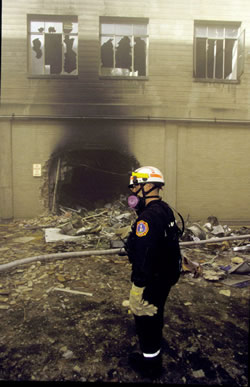
This
photo shows a hole punched through the Pentagon wall at the back of the damaged
area.
Lets
find it’s exact location. http://www.geoffmetcalf.com/pentagon/images/16.jpg Here’s
the same scene from a different angle. You can now see all of the hole .
It
appears to be at angle of something like 45 degrees from the first ring damage
area. How much stone has been penetrated to make this hole? Assuming no internal
walls, 6 walls. If each wall is 3 feet thick, that’s 18 ft of stone, plus or
minus any inaccuracy of the guess of the thickness of the walls, perhaps plus
anything that was in the way, inside the buildings. Because its at a 45 degree
angle, whatever has made it has actually had to punch out 27 ft of
stone. An
explosion that digs tunnels? Not even the hard line 757 enthusiasts are
suggesting that this was caused by the impossible explosion. The logical
explanation is a missile. The 757 supporters claim that it was punched through
the wall by one of the plane’s engines. The
engines are mounted on the wings. The wings were allegedly cremated. How did the
engine not only escape disintegration, but propel itself forward two to three
rings beyond where any of the rest of the plane got to? (Three rings beyond
refers to some scenarios that the plane never actually penetrated the building
but crashed just outside). There
are only two available energy sources for any part of the plane to move through
the wall. The momentum of the plane, and the alleged force of the explosion. If
the energy source was the latter, why did it propel one small part of the plane
forward, while destroying the rest of it? And if the energy source was the
momentum of the plane, why hasn’t the 100 ton fuselage burst through the rings,
instead of the 6 ton engine? I’m
going to try to construct the best argument I can that this was caused by an
engine. The engine became disconnected from the wing before the plane blew up.
Otherwise the engine would have blown up too. That’s
the best I can do, but there are huge problems. For
a start, the engine weighed about 6 tons, according to these specifications for
similar engines http://home.swipnet.se/~w-48037/l1011techsp.htm (Note:
The weights listed next to the engine on the Boeing technical site referenced at
the beginning of the article, do not refer to the engine's weight, but to its
thrust power.) Its
a little difficult to imagine that the mountings attaching an engine of this
weight could be so critically weakened by hitting a pole, but never mind -
ignoring reality has become a regular necessity for any attempt to keep the 757
theory alive. Lets press on. If
we speculate that the nose of the 100 ton plane hit the wall, and stopped dead,
hardly penetrating, then we can’t seriously suggest that an engine, 6% of the
weight, now travelling at a lesser speed than what the plane would have been
doing when it hit the wall, could punch it’s way through three rings. If the
plane hit the ground, and stopped dead, a few feet from the wall, and then blew
up, where is the 155ft fuselage crater, and the sideways damage from the wings?
That’s without the explosion. Where is the circle of devastation which should be
a radius of something more than 77 ft? This photo demonstrates that this didn’t
happen. http://66.129.143.7/june2aa.htm If
the engine didn’t detach until after the explosion then it can’t have outrun the
blast. Everything would have been blown up together. If the engine detached from
the shock of impact, as the nose hit the wall, and then flew towards the wall,
the nose had no reason to stop penetrating the wall until the explosion blew it
up. This means that the nose was always further forward than the engine, so if
the nose is blown up, so is the engine. If we postulate an angle for the plane
and a position for the nose, to try to create a scenario that the engine shoots
wide of the blast area, then it’s also shooting wide of the impact area. You’d
have to produce evidence of a second entry point. Whichever engine it was, it
has to pass through the 65 ft hole area, and in any scenario where the nose
penetrates the wall, it’s going to pass through later than the nose. And since
they must both be travelling into the building at the same angle, then the
distance between them will never widen as a result of
angle. So
unless you want to suggest that the engine actually fired from the wing before
the impact ( like a missile ), then any scenario which has the nose penetrating
the wall is impossible. In case someone suggests that the engine fired off
immediately upon hitting a light pole, I’ll point out that they’re built to
withstand that kind of contact, and even if they weren’t, that would knock the
engine backwards, not shoot it ahead of the plane. In fact, whatever the cause
of it’s detachment, if it came off when the plane was still moving, it’s
impossible for it to have been fired off faster than what the plane was moving,
so if anything happened beforehand, it would have fallen off, not shot forward
like a missile. If
the scenario involving the nose hitting the wall is impossible, and the scenario
of the nose not hitting the wall is also impossible, then it didn’t
happen. So
it was a missile. But lets pretend that the previous analysis doesn’t exist and
look at other aspects of this question, pretending that the engine theory is
still alive. Lets
pretend that it was possible for the plane to stop short of the wall and blow up
outside, ignoring the lack of damage to the lawns, and say that the engine was
jolted free by the previously speculated method, and managed to outrun the
blast, before the plane blew up. http://www.airliners.net/open.file/281582/L/ The
engine would have about 60 ft to travel to strike the wall, allowing for the
plane stopping 5 ft short of the wall. (90 degree fuselage angle) Angling the
fuselage at 45 degrees to make the engine’s flight path compatible with the
direction of the third ring hole, makes negligible difference to the distance
from engine to wall, as long we postulate that it was the inner wing engine. If
it was the outer wing, it has to travel about 120 ft to strike the wall. Also,
the effective horizontal width created to the north (assuming the plane to have
approached from the south) by the outer engine angle, means that the front of
the fuselage has to be placed hard against the right edge of the 65 ft hole, to
fit the engine's entry point into the damaged area. This is significant, because
we are now postulating a scenario where the wall suffered no impact other than
the engine strike and the explosion. It’s impossible to make a credible case for
the fuselage cremation happening hard up against the edge of the hole, when just
a few feet away windows were unbroken. So we need to assume that it was the
inner engine. This enables the nose to be placed close to the centre of the area
of 65 ft damage, while still allowing the engine to fire through the damaged
area, avoiding the problem of having to suggest a non-existent second entry
point. So
the engine had about 60 ft to travel to the wall. At 440 ft per second this
would take close enough to 150 milliseconds. If the plane blew up before this,
the engine would be toasted along with everything else, because it’s travelling
a line which takes the inner side of it only 15 ft from the exploding fuselage.
So even if had reached the wall, that still wouldn’t save it. We really need to
give it time to burrow into the wall a safe distance from the blast. If it’s
speed halved to 220 ft per second, when it struck the wall, then it would take
about another 50 ms to fully enter it’s 11.5 ft length into the wall, and we
need to allow another 50 ms for it to burrow a further 10 ft to be safe. Even
this might not be enough because it’s penetration path is crossing the middle of
the This
is what had to happen. The plane can’t have hit with the nose pointing sharply
down into the ground, because then the engine would have been fired into the
ground. So it had to land just about level, but stop dead - like a sudden 90
degree belly flop straight out of a momentum of 400 mph. Then we have to
postulate a 250 to 300 ms delay, before it suddenly blows up with a ferocity
never before seen in aviation history. During this delay, we have to postulate
that it didn’t break up significantly, otherwise other wreckage would have gone
flying off and also escaped the blast. Then it suddenly cremated itself, and did
all this without damaging the lawns that it belly flopped on to.
Impossible. Postulating
tilted wings to try to change distances and angles only makes it worse. If the
wings were tilted at 45 degrees, then the lowest point of the upper engine is
about 55 ft off the ground, and the lowest point of the lower engine is about 20
ft off the ground. Since the hole is at ground level, you’d have to describe a
precise downwards angle for the nose to get the engine to finish up at ground
level after its penetration through the rings. But the bigger problem here is
that the nose can’t have hit the ground with the wings tilted, because the lower
wing would have broken off first. This makes it rather difficult to suggest the
sudden stop necessary to fire off the upper engine wing with any speed. When is
the sudden jolt ? When the wing breaks off, or when the nose hits? We probably
have to speculate a halved speed for the engine now - if it could still happen
at all - meaning that the delay before the explosion is now 500 - 600 ms, which
is getting quite ridiculous, and the engine is now lacking the power it needs to
have any chance of charging through 27 ft of stone, which is now a bit more,
because its being fired from a raised angle. So if you want the wings tilted,
you have suggest that the nose was hitting the wall, which takes us back to the
same problems that first led us to suggest that it must have hit the ground
instead. And its even worse now. With the wings tilted at 45 degrees, the nose
would be hitting the wall at a height of about 40 ft, meaning that we have to
suggest that it simply bounced off, or stuck in the wall and hung there (while
the engine powered through the wall) or if the nose burst through the wall,
we’re back to the same old problems. So
the whole engine theory is impossible all round, which ever way you look at it.
Nevertheless, lets pretend its still alive and press on. There’s
the question of whether the momentum and weight of the engine was enough to
power it’s way through 3 rings of the building. During
WW 2, the British developed the “Tall Boy” Bomb It
weighed 12,000 lb and could punch it’s way through 10 ft of steel reinforced
concrete, when dropped from a great height ( a Lancaster bomber) Very
impressive! The Pentagon may not be as strong, but the engine is alleged to have
punched through nearly triple this width. The engine weighs http://www.accessweb.com/users/mconstab/bombs.htm
|