|
This
is a significant comment. [[ "You could basically sit in that tank with a lit
cigarette and snuff the cigarette out in the fuel and it won't explode... Your
agency has been depicting the volatility of the fuel as if it were
nitrobenzene." ]] 5
years later, with the occurrence of the Sept 11 crashes, the allegedly explosive
nature of jet fuel has been further ramped up to the power of
dynamite. Of
course ,the article also cites opinions rebutting Donaldson’s remarks, but it
reinforces the point that a glib statement that “AA 77 blew up and disintegrated
to nothing - perfectly normal, end of story, what’s the all argument about? ” is
not credible. The
controversy over TWA 800 continues, shedding more light on how ridiculous is the
claim that it was a full fuel load which blew AA 77 into nothing. In this
extract, a supporter of the official TWA 800 story suggests that a full fuel
tank is safer than an empty one. http://members.aol.com/bardonia/prime.htm
(June 1997) [[Large
airliners don't need to fill up all their fuel tanks for most of their flights.
They save money and reduce the risk of accidents by not carrying excess fuel.
Loeb sees a hazard in this. TWA 800, with no more than 100 gallons of fuel in
its big center wing fuel tank, had been waiting two hours to take off. Loeb
claimed on PrimeTime Live that its air-conditioning packs, located beneath the
fuel tank, heated the fuel enough to vaporize some of it, creating what host Sam
Donaldson called "a virtual bomb ready to explode." Loeb admitted that the
investigators had not been able to find anything that might have ignited this
"bomb," but he brushed that aside, saying if there had been no explosive vapor,
there would have been no accident. ]] So,
even those who are claiming that TWA 800 went down because of an exploding fuel
tank, have as a central part of their theory, that a full fuel tank reduces the
risk of explosion. From the same article [[The
New York Times reported that the NTSB planned to set off a 747 center wing fuel
tank explosion this year to see if the vapor from 100 gallons of fuel would have
enough force to break a 747 in two. That important test has not been made, and
there are no plans to make it. Instead, the NTSB plans to explode a small bomb
near the center wing fuel tank of a 747 in England in July to see what kind of
damage a small shaped charge will do and "more importantly," they say, what
sound it will make. ]] So
they’re arguing about whether an exploding fuel tank can even break a plane in
two, not whether it can reduce it to dust and ashes. According to their
theories, it can’t explode if it’s full (it still wouldn’t have enough energy
anyway) and if it’s empty enough to explode, it’s arguable whether it could
break a plane in two. Herald
International Tribune July 24 1996 http://www.aircrash.org/burnelli/ht960724.htm [["If
it was an accident, it would scare the hell out of us," said Michael Barr,
director of aviation safety programs at the University of Southern California.
"These planes just don't blow up. There's too many fire walls, too many checks
and balances.' And
yet, this explosion, of a violence unprecedented in aviation history still left
lots of wreckage. http://www.airsafetyonline.com/photos/twa800/1.shtml From
the same article [[The
specific fuel involved is called Jet A, a derivative of kerosene and a sluggish
explosive. To explode, it must mix with air, an indication that one or more of
the eight fuel cells in the jumbo jet's wings were breached--either by violent
engine or mechanical failure, by a well- placed bomb or possibly by a missile.
This
mentions a fiery explosion at the Lockerbie site, when fuel laden parts hit the
ground. I’m not saying that no explosion can occur. What I’m saying is that it’s
not easily triggered, and doesn’t have enough energy to cremate a plane. In the
case of the Lockerbie bombing, the bomb itself was not enough to trigger an
explosion of the fuel tank. Since the plane broke up into five sections, the
impact of the exploding fuel upon the full wreckage could not be tested. Here’s
one section of the wreckage. http://www.airsafetyonline.com/photos/panam103/1.shtml So
if a bomb, breaking a plane into 5 pieces, still doesn’t trigger a sudden
explosion of the fuel tank, then what does? Crashing into something solid, like
a mountain or a building - but apparently only on Sept 11, 2001.There’s no
evidence that an explosion of the type and power alleged to have cremated AA 77
or the WTC planes has ever happened to any other plane, or ever could in the
situation of a normal crash. Although the political circumstance behind the Sept
11 crashes, and (in the case of WTC crash 2 ) the spectacular imagery involved
was unprecedented, there was nothing unusual in the impact physics of the
crashes. Planes regularly crash into mountains, streets, the ground, buildings
and other planes, and are not cremated. Web
author Jack Cashill writes (August 16 2001) http://www.worldnetdaily.com/news/article.asp?ARTICLE_ID=24075 [[Until
recently, the only listed "fuel tank explosion" in the 80-year history of
airline disasters was a Philippine Air Lines 737 that blew while the plane was
backing out a Manila airport gate in May of 1990. And even this case is suspect.
]] In
all of these cases significant wreckage - at least - survived. In some cases,
the whole plane. So many are saying that even the alleged explosion of jet fuel
aboard TWA 800, which left plenty of identifiable wreckage, was impossible. If
the official story on TWA 800 is a cover up, then the fuel tank never exploded,
and the whole matter of an allegedly exploding fuel tank even breaking a plane
in two is an outrageous lie. If the official story is correct, or at least
genuinely plausible, then fuel tank explosions are only a risk with near empty
tanks, and don’t have anything like the necessary energy to disintegrate a
plane. And photographic records of aviation disasters demonstrate that fuel tank
explosions don’t happen as a result of regular crashes, or if they do they don’t
cremate the planes. In
the entire history of aviation, only four passenger jets have ever exploded into
nothing, or are alleged to have done so as a result of a crash. All four just
happen to have been the Sept 11 planes. And in the case of the WTC, the impact
surface was mostly glass - about as soft a target as a plane can hit, with the
possible exception of water. So this debunks any assertion that the alleged
explosion of AA 77 was a result of being flown into a fiercely resistant
surface, which itself is already debunked by examples of planes which flew into
mountains and weren’t cremated, including the earlier linked photo of an
American Airlines 757 which crashed into a mountain. That’s about as conclusive
a comparison as one can get. The only possible conclusion is that the WTC planes
had powerful explosives aboard, and that whatever hit the Pentagon was a much
smaller object, also destroyed by explosives. Not
only was the alleged explosion of AA 77 impossible in the context of the modest
damage to the Pentagon wall , and impossible because there wasn’t enough energy
in the fuel - it’s also been shown anecdotally to be impossible in the context
of aviation history. Nevertheless,
I’m once again going to suspend these findings, to examine another
aspect. PART
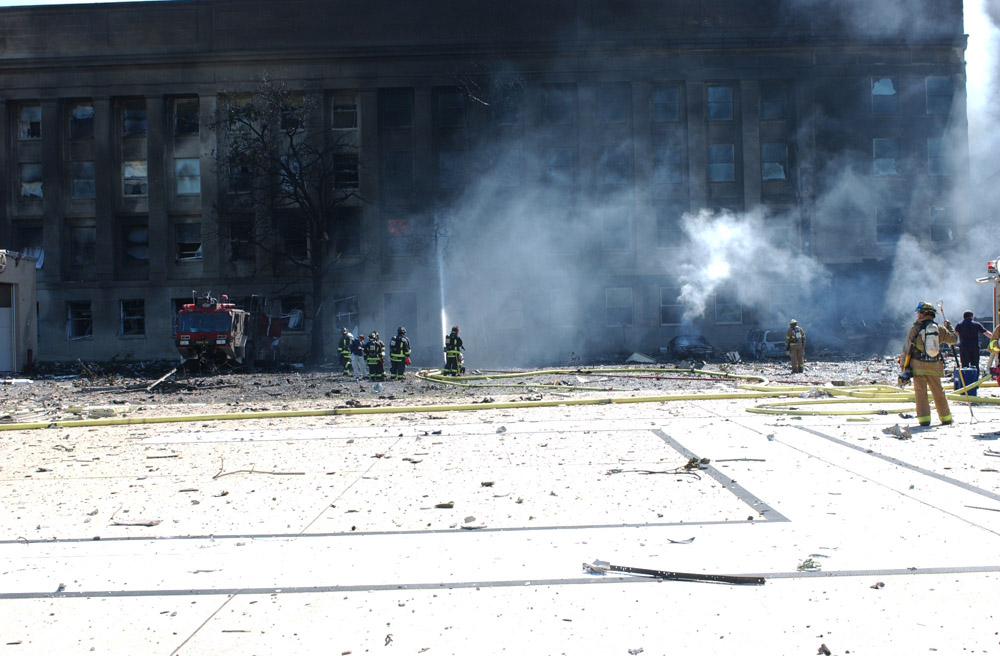
8. “BUT WRECKAGE WAS FOUND.” So
lets have a look at the photos of the alleged wreckage. http://www.geoffmetcalf.com/pentagon/images/11.jpg
Additional
to the fact that this represents less than 0.1 % of the volume of the alleged
plane, what evidence is there that any of this was once part of a Boeing 757 ?
It could be from anything. We know that something hit the Pentagon, that there
was an explosion, and that where there is an explosion there will be debris of
some sort. Supporters
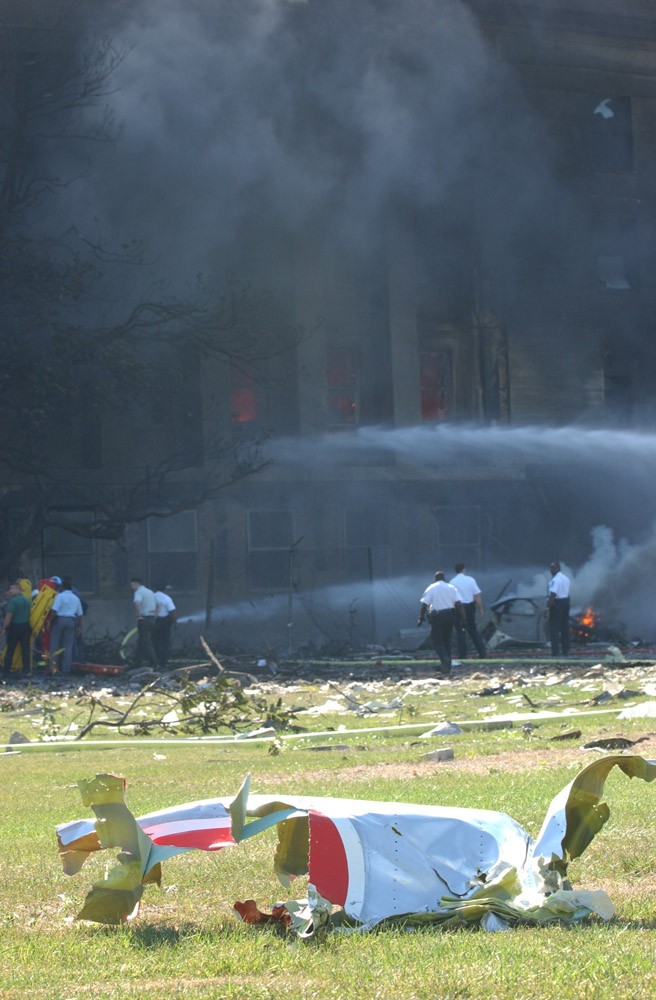
of the 757 theory claim this fragment to be wreckage from AA 77, citing the AA
colours as proof. http://www.geoffmetcalf.com/pentagon/images/13.jpg In
fact, it is the alleged AA colours which prove conclusively that this cannot
possibly be part of the alleged plane. Has American Airlines invented a new kind
of indestructible paint? This fragment has allegedly been violently flung out
from an explosion which reduced a giant airliner to the dust and ashes and
unidentifiable tiny fragments shown in the above photo. And yet the paint is as
shiny and new as the day it was applied. Does it take more energy to peel and
blacken paint, than to destroy 100 tons of aircraft? Clearly painted sections
survive most crashes, as shown in the crash photos. But in those cases, no one
is alleging an explosion catastrophic enough to vaporize 100 tons of plane. They
break up and perhaps burn a bit. In really fierce crashes, some of the plane may
actually be destroyed, but even in these cases, tons of reasonably intact
wreckage remains. So these scenarios are consistent with the recovery of painted
sections, even in bad crashes. The allegation that this brightly painted
fragment survived is irreconcilable with the claim that 99.99% of the plane was
vaporized. There’s
a further problem with this piece of wreckage. The colours are wrong anyway.
Take a close look at the colour scheme used by American Airlines. First, note
that the alleged wreckage has a white stripe next to red which is of a larger
area than the white stripe. Note the absence of any blue stripe. Now let’s look
at some actual AA plane photos and you’ll see that that this colour scheme isn’t
used. Except possibly in the American Airlines lettering on the top front part
of the fuselage, a point I’ll come back to. This
link will take you to a page with thumbnail photos of American Airlines planes.
I chose not to supply the direct links to the enlarged thumbnails, because the
URLs were extraordinarily long, and faced a significant risk of breaking once
published on the web. http://www.airliners.net/search/photo.search?airlinesearch=American%20Airlines&distinct_entry=true Note
that the striped colour scheme which the crude fake has attempted to copy does
not appear on the wings or tail fins. The reason I make this point, is that this
rules out the possibility that this piece of the plane was sheared off during
the approach, before the explosion, by hitting a light pole. If there’s any
possibility that it’s a genuine AA colour scheme, it can only have come from
part of the American Airlines lettering, on the top and front part of the
fuselage, which means that this piece could not have been sheared off on the way
in, and therefore must have been subject to the explosion. And that is
impossible, even if we were to pretend that such an explosion was generally
possible. Furthermore the only part of the plane which it could possibly have
come from is towards the front. If the explosion occurred in the middle of the
plane, debris from the front area would have been flung forwards into the
building not away from it. And if the explosion occurred in the front part of
the plane, making it possible to blow this piece backwards, then this area of
the plane would have been subject to the most powerful part of the blast, so if
we were going to see surviving pieces of debris flung backwards, (especially
with paintwork still intact ) they should be from the rear of the plane. And if
it’s alleged that it was thrown forward with such force that it hit something
else and bounced back all this distance, wouldn’t the paintwork, be just a
little scratched? |