The Federal Zone:
Cracking the Code of Internal Revenue
Eleventh Edition
by
Paul Andrew Mitchell, B.A., M.S.
Counselor at Law, Federal Witness,
and Private Attorney General
Published by
Supreme Law Publishers
c/o Lake Union Mail
117 East Louisa Street
Seattle 98102
WASHINGTON, USA
March 1, 2001 A.D.
This book is designed to educate you about federal income tax law, the Treasury regulations which promulgate that law, and the various court decisions which have interpreted both. It is sold with the understanding that the Author and Publisher are not engaged in rendering legal services of any kind. The right to author and publish this book, no matter how often the statutes, regulations and case law are quoted, is explicitly guaranteed by the First Amendment to the Constitution for the United States of America, a written contract to which the federal government, the 50 States, and their respective agencies are all parties. Federal and State laws are changing constantly, and no single book can possibly address all legal situations in which you may find yourself, now or in the future.
The Federal Zone:
Cracking the Code of Internal Revenue
Common Law Copyright
March 1, 2001 A.D.
Paul Andrew Mitchell, B.A., M.S.
Counselor at Law, Federal Witness,
and Private Attorney General
The
information contained in this book is lawfully protected from copyright
violations and reproduction infringements of any kind. Violators are
hereby warned that they can and will be prosecuted to the full extent of
American law, at the sole discretion of the Author and Publisher. DO NOT COPY without prior written permission
of the Publisher. The sole exception to
this copyright limitation is the privilege, hereby granted by the Author, to
incorporate brief quotations in critical articles and reviews, which articles
and reviews may, of course, be published for profit or gain by their respective
authors and publishers.
Published by:
Supreme Law Publishers
c/o Lake Union Mail
117 East Louisa Street
Seattle 98102
WASHINGTON, USA
WITH EXPLICIT RESERVATION OF ALL RIGHTS
AND WITHOUT PREJUDICE TO ANY RIGHTS
PER UNIFORM COMMERCIAL CODE
ARTICLE 1, SECTION 207
(UCCA 1207 in California)
(See Appendix F,
Paragraph 38, for details.)
This book is
protected by a Common Law Copyright under the name of the Author -- Paul Andrew
Mitchell, B.A., M.S., Counselor at Law, Federal Witness, and Private Attorney
General.
One of the main purposes of this book is to explain how We, the American People, have been deliberately deceived by government officials who have systematically exploited this deception, to defraud us of our wealth and our freedom.
If
you make unauthorized copies of this book without paying the Author for those
copies, you are obtaining unjust enrichment by doing so, and therefore you are
no different from the government employees who are stealing from you. In other words, you are a criminal!
Your
continued financial support will be most appreciated and will be spent to cover
the time and expenses of people in the Freedom Movement who are now dedicating
precious time and energy to defend your rights and your freedoms. Please honor this work.
To order additional copies, or to donate funds to cover unauthorized photocopies, please dispatch first class mail to:
Supreme Law Publishers
c/o Lake Union Mail
117 East Louisa Street
Seattle 98102
WASHINGTON, USA
This United States Postal Service requires first class
mail to bear postage at the minimum rate of $0.45 for the first ounce, without
exception.
First Class Mail:
$154.95 (includes autographed and embossed hard copy,
shipping and handling via
priority U.S. mail)
Express Mail:
$169.95 (includes autographed and embossed hard copy,
shipping and
handling via express U.S. mail)
We now accept
only cash and blank postal money orders.
A blank postal money order shows nothing on the "PAY TO" line,
allowing us to write our own payee on this line, and to negotiate the money
order freely. Sorry, but we do not
invoice, ship COD, or accept credit cards.
We reserve the right to endorse money orders "without prejudice UCC
1-207" and without granting jurisdiction (see Appendix F). If you are worried about lost mail, the USPS
will insure your prepayment for a modest fee.
Thank you
very much for your interest and support.
First Edition
January 1992 hard-copy
Second Edition July 4th
1992 hard-copy
Third Edition
January 1993 electronic
Fourth Edition July 4th
1993 electronic
Fifth Edition
January 1994 hard-copy
Sixth Edition destroyed
by the "IRS"
Seventh Edition
January 1997 hard-copy
Eighth Edition June 21,
1998 hard-copy
(Author's
50th birthday)
Ninth Edition March 1,
1999 hard-copy
Tenth Edition September
1, 2000 hard-copy
Eleventh Edition March 1, 2001 hard-copy
An order form
for this book is available from Internet URL:
http://www.supremelaw.org/fedzone11/order.htm
Please read all stated instructions before placing
orders.
We reserve the right to change prices and/or terms at any time, without advance notice of any kind.
The Supreme
Court has officially defined the key term "United States" to have
three separate and distinct meanings:
(1) It may be the name of a sovereign occupying
the position of other sovereigns in the family of nations.
(2) It may designate the limited territory over
which the sovereignty of the federal government extends.
(3) It may be the collective name for the fifty
States which are united by and under the U.S. Constitution.
Understanding
these several meanings is absolutely crucial to understanding the
remainder of this book. Much confusion
will result from failing to recognize (or decipher) the meaning that is used in
any given context. In order to reinforce
their importance, these three meanings will be identified by using the
following convention whenever possible:
(1) United
States* or U.S.* (first meaning)
The name of the sovereign Nation, occupying the position of other sovereigns in the family of nations.
(2) United States** or U.S.** (second
meaning)
The federal government and the limited territory over which it exercises exclusive sovereign authority.
(3) United States*** or U.S.*** (third meaning)
The collective name for the States united by and under the Constitution for the United States of America.
At the risk
of being criticized for violating formal English style, quotations have also
been modified with this notation. The
risk of misunderstanding was judged to be far more serious, than any violations
of conventional style. It is the
Author's sincere intent that the addition of the asterisks will be obvious in
all cases, even if the meaning of "United States" is not immediately obvious in any given
case.
Exceptions to
this convention will be made for book titles, for United States Codes
(abbreviated "USC" or "U.S.C."), for the United States (or
"U.S.") Constitution, and for the United States (or "U.S.")
Supreme Court (also abbreviated "S.Ct.")
Other notations should be obvious from their context,
but will be repeated here for extra clarity:
IRS means Internal Revenue Service
in the Department of the Treasury (not
the U.S. Department of the Treasury)
IR means Internal Revenue (e.g. IR Manual refers to the IRS Internal Revenue Manual)
U.S. means United States decision
when used to cite a ruling of the U.S. Supreme Court (e.g. 324 U.S. 652 refers
to volume 324, page 652, of U.S. Supreme Court decisions)
USC means United States Code
(e.g. 26 USC 7701(a) refers to Title 26 of the United States Codes,
Section 7701(a)), and appears more often as "U.S.C."
IRC means Internal Revenue Code
(also known as Title 26 of the
United States Code, but these are not
one and the same)
CFR means Code of Federal Regulations
(e.g. 26 CFR 1.871-1 are the regulations for Section 871 of Title 26)
T.D. means Treasury Decision, a
written decision published in the Federal Register by the U.S.
Department of the Treasury
If a nation expects to be ignorant and
free,
in a state of civilization,
it expects what never was
and what never will be.
Thomas Jefferson
Help
us to abolish the
specter
of modern slavery
which
now threatens to destroy
the
essential rights and freedoms
which
made this a great nation
and
the envy of others
around
the world.
Help
us to restore a government
which
has drifted so far off course
it
hardly resembles
the
constitutional republic
it
was designed to be.
from Cover Page
Notice to 50 Governors
Account for Better Citizenship
(see the Guarantee Clause for
authority)
If Frank Brushaber
was a nonresident alien
with respect to the federal zone, then
so am I,
and so are millions of other
Americans,
who will know the truth if We teach them.
Before the 14th amendment [sic]
in 1868:
... [F]or it is certain, that in the sense in which the
word "Citizen" is used in the federal Constitution, "Citizen of each State," and "Citizen of the United States***,"
are convertible terms; they mean the
same thing; for "the Citizens of
each State are entitled to all Privileges and Immunities of Citizens in the
several States," and "Citizens
of the United States***" are,
of course, Citizens of all the United States***.
[44 Maine 518 (1859), Hathaway, J.
dissenting]
[italics
in original, underlines & C's added]
After the 14th amendment [sic]
in 1868:
It is quite clear, then, that there is a citizenship of the United States** and a citizenship of a State, which are distinct from each other
and which depend upon different characteristics or circumstances in the
individual.
[Slaughter House Cases, 83 U.S.
36]
[(1873) emphasis added]
The first clause
of the fourteenth amendment made negroes citizens of the United States**,
and citizens of the State in which they reside, and thereby created two classes of citizens, one of the United
States** and the other of the state.
[Cory et al. v. Carter, 48 Ind. 327]
[(1874) headnote
8, emphasis added]
We have in our
political system a Government of the United States** and a
government of each of the several States.
Each one of these governments is distinct from the others, and each has citizens of its own
....
[U.S. v. Cruikshank, 92 U.S.
542]
[(1875) emphasis added]
One may be a citizen of a State and yet not a citizen of
the United States. Thomasson
v. State, 15 Ind. 449; Cory v.
Carter, 48 Ind. 327 (17 Am. R. 738);
McCarthy v. Froelke, 63 Ind. 507; In Re Wehlitz,
16 Wis. 443.
[McDonel
v. State, 90 Ind. 320, 323]
[(1883) underlines added]
A person who is a citizen of the United States** is
necessarily a citizen of the particular state in which he resides. But a
person may be a citizen of a particular state and not a citizen of the United
States**. To hold otherwise would be to deny to the
state the highest exercise of its sovereignty, -- the right to declare who are its
citizens.
[State v. Fowler, 41 La. Ann.
380]
[6 S. 602 (1889), emphasis added]
The first clause
of the fourteenth amendment of the federal
Constitution made negroes citizens of the United States**, and citizens of the
state in which they reside, and thereby created
two classes of citizens, one of the United States** and the other of the state.
[4 Dec. Dig. '06, p. 1197, sec. 11]
["Citizens" (1906), emphasis
added]
There are, then,
under our republican form of government, two classes of citizens, one of the
United States** and one of the state. One class of
citizenship may exist in a person, without the other, as in the case of a
resident of the District of Columbia;
but both classes usually exist in the same person.
[Gardina
v. Board of Registrars, 160 Ala. 155]
[48 S. 788, 791 (1909), emphasis
added]
There is a
distinction between citizenship of the United States** and citizenship of a particular state, and a person may be the
former without being the latter.
[Alla
v. Kornfeld, 84 F.Supp.
823]
[(1949) headnote
5, emphasis added]
A person may be a citizen
of the United States** and yet be not
identified or identifiable as a citizen of any particular state.
[Du Vernay
v. Ledbetter]
[61 So.2d 573, emphasis added]
... citizens of
the District of Columbia were not granted the privilege of litigating in
the federal courts on the ground of diversity of citizenship. Possibly no better reason for this fact
exists than such citizens were not
thought of when the judiciary article [III] of the federal Constitution was drafted. ... citizens
of the United States** ... were also
not thought of; but in any event a citizen of the United States**, who is not a citizen of any state, is
not within the language of the [federal] Constitution.
[Pannill
v. Roanoke, 252 F. 910, 914]
[emphasis added]
Contents: Page
Disclaimer
................................................... ii
Special Notice
.............................................. iii
Notations
..................................................... v
Dedications
................................................. vii
Table of Contents (this page) ................................
ix
Preface to the 8th Edition
.................................. xii
Introduction
.......................................... intro - 1
Chapter 1: The Brushaber
Decision ........................ 1 - 1
Chapter 2: Status and Jurisdiction
....................... 2 - 1
Chapter 3: The Matrix
.................................... 3 - 1
Chapter 4: The Three United States
....................... 4 - 1
Chapter 5: What State Are You In?
........................ 5 - 1
Chapter 6: Empirical Results .............................
6 - 1
Chapter 7: Inside Sources
................................ 7 - 1
Chapter 8: Is it Voluntary?
.............................. 8 - 1
Chapter 9: The Law of Presumption
........................ 9 - 1
Chapter 10: The Fundamental
Law .......................... 10 - 1
Chapter 11: Sovereignty
.................................. 11 - 1
Chapter 12: Includes What?
............................... 12 - 1
Chapter 13: Amendment 16 Post Mortem ..................... 13 - 1
Chapter 14: Conclusions ..................................
14 - 1
Appendices
..................................... (see next pages)
Table of Contents
All
appendices in the eleventh edition of The Federal Zone are available for
free from the Supreme Law Library at
Internet URL:
http://www.supremelaw.org/fedzone11/index.htm
Hypertext links and graphics will be added to these Internet documents, as soon as time and resources permit.
These appendices are available in hard
copy by special order only, in order
to conserve paper and minimize shipping weights.
A Letter to John Knox and his Memorandum of Law ........ A - 1
B Omnibus Acts ......................................... B - 1
C Treasury Decision 2313 ............................... C - 1
D Form 1040 for 1913 ................................... D - 1
E Viacom Transcript .................................... E - 1
F Affidavit of Rescission .............................. F - 1
G Deceptive IRS Code Words ............................. G - 1
H Analysis of U.S. v. Hicks ............................ H
- 1
I Notice to 50 Governors ............................... I - 1
J Petitions to Congress ................................ J - 1
K IRS Form 1040NR ...................................... K - 1
L IRS Form W-8 ......................................... L - 1
M List of Organizations ................................ M - 1
N Bibliography ......................................... N - 1
O Constructive Notice and Demand ....................... O - 1
P Miscellaneous Letters ................................ P - 1
[more ...]
Table of Contents
Appendices: Page
Q Apportionment Statute ................................ Q – 1
R Affirmations: Within & Without ....................... R – 1
S Affidavit of Foreign Status .......................... S – 1
T Revocation of Birth Certificate ...................... T – 1
U Revocation of Voter Registration ..................... U – 1
V Affidavit of Applicable Law .......................... V - 1
W Memos on Downes v. Bidwell
........................... W - 1
X Certificate of Exemption from Withholding ............ X - 1
Y Memoranda of
Law by Richard McDonald ................. Y - 1
Z Nature and Cause: Case
Law .......................... Z - 1
Many more
documents are now available in the Supreme
Law Library at Internet URL:
http://www.supremelaw.org/library/index.htm
An excellent point of entry for the new user is the Press Releases and the web pages linked to them. Begin at URL:
http://www.supremelaw.org/press/rels/index.htm
These documents are free to the entire nation, and to the whole world as well, using standard Internet computers.
Your generous donations will help us to continue this vital work, to ensure that its many fruits will remain available to our youngest Citizens and to generations yet unborn.
See
the Supremacy Clause for the seminal authority.
#
# #
The history
of this book, since it was first published in the year 1992, has been nothing
if not tumultuous. With a limited
private budget, and no help at all from any commercial publishing companies,
the second edition of The Federal Zone was perfect-bound by an automated
bindery and started shipping, most often in quantities of one or two, at a law
conference in Sacramento, California, on the Fourth of July. The bright, professional cover, printed in
two colors, was a welcome change from the amateur designs adopted by many other
authors writing on similar subjects.
Nobody else had thought to shrink-wrap their freshly bound books either.
For the
remainder of that year, this author spent every waking hour shipping books,
sometimes by the case load, to customers in every State of the Union. What time remained was spent answering a
mountain of correspondence, doing further research and bolstering the solid
legal foundation already built for one specific purpose: to dismantle the IRS totally, once and for
all. This is a worthy goal, for the
entire nation.
It was an
exhilarating time, to be sure, and a mixed blessing when the initial run of
2,500 copies was quickly exhausted. The
praise for its indisputable authority, consistent rigor, and almost stubborn
fidelity to proven fact, was nearly unanimous.
Although the
revenue stream was substantial, the cumulative costs of continuing research,
office overhead and living expenses made it impossible to pay the automated
bindery for a second large print run, using the author's private funds. A plan was hatched to solicit investors who
would pre-pay one thousand dollars each, in return for receiving one hundred
bound copies "drop-shipped" directly from the bindery.
This was a
good deal, because each investor would pay a "wholesale" price of
only ten dollars per book, compared to the "retail" price of forty
dollars (fifty dollars for the first edition).
Four investors had fronted one thousand each, and that sum of four thousand
dollars was "safely" deposited in a trust account at Wells Fargo
Bank, in San Rafael, California, when disaster struck.
As it turned
out, the Internal Revenue Service was watching, and they were hopping mad about
the book. Nobody had ever pulled the rug
out from under them quite like that, before then -- not in such a neat,
professional package which was soon racing around the country and setting
precedents in the history of American constitutional jurisprudence. So, like Nazis burning books in the town
square at noon, the IRS cranked out a "Notice of Federal Tax Lien,"
strolled into Wells Fargo Bank, and strolled out with a cashier's check -- four
thousand dollars worth, to be exact.
All of this
happened, of course, without any notice or hearing from anyone, and certainly
without the court order which is an absolute prerequisite before a bank account
can be levied. So, in many ways, the IRS
had become much worse than Nazis.
German Nazis at least provided their
victims with ample notice of a pending book-burning, by inviting the town's people
to witness cans of gasoline pouring over gutted library contents, piled high
and deep in the local town square, as one lit match reduced their store of
knowledge to ashes. In Amerika, the IRS steals the money being saved to print
books, and nobody learns about it until the event is long past. At least, the Nazis were honest about
it. Here, the books never even made it
into print. California, 1993!
The only real
inventory, at that point, was the electronic fourth edition. A fateful decision was made to begin shipping
"shareware" copies of the book on 3.5" floppy disks written by
the author's personal computer -- an Intel 80386 CPU running DOS version 5 from
Microsoft.
By that time,
a healthy market had developed in the computer industry, whereby independent
programmers could distribute commercial software on the "honor"
system. Computer programs would be
copied or "shared" for free, and users would pay the original
programmer a modest "shareware" fee if the software was found to be
useful to them. This mode of
distribution produced decent revenues for many independent programmers, because
their users honored the rules, to everyone's advantage. The shareware fee for The Federal Zone
was a mere $25.00.
With high
hopes that the freedom movement [sic]
would play by the same rules, an electronic copy began to circulate around the
country, with no way to track either copies or readers. Sadly, shareware revenues amounted to a
miniscule pile of small change, forcing this author into a painful and protracted
period of acute depression, both financial and emotional.
This was an
extremely bitter lesson about the real American mind set, at that point in
recent history. Many potential readers
had expressed what appeared to be genuine concerns about federal government
attacks on the fundamental Rights of all Citizens.
The U.S.
Constitution is explicit about the importance of securing to authors the
exclusive Right to their respective writings.
And yet, the very same people who claimed to have such a deep and
abiding commitment to defending, and promoting, such fundamental Rights, were
often the first to steal The Federal Zone and to pass stolen copies to
everyone who would listen.
One copy was
even modified, in blatant violation of stated copyright restrictions, and
posted without this author's permission on the Internet, made vastly
popular by the first commercial "browser" in Netscape's
Navigator. That stolen copy remains
today on the Internet file servers at America Online, Inc., whose corporate executives
refuse to honor this author's copyrights either, even after receiving numerous
written notices.
The
punishments, threats, retaliation, and reprisals did not stop there. Cars with tampered front brakes, physical
assault, death threats, false arrest, false imprisonment, defamation and
intentional starvation would follow.
The first of
several court battles was not long in coming.
The research which formed this book's solid foundation, had to happen
initially during moonlight hours, while this author worked full-time doing
systems development for a major investment bank in San Francisco. The pay was excellent, and there was no
withholding, by choice. Remember, the courts
had already ruled that compensation for services rendered was not "income",
as that term is used in the Internal Revenue Code ("IRC"). At the end of 12 months, a 6-figure salary
was bound to attract IRS attention, even without
the recent publication of the book.
The IRS then
issued an administrative summons, which this author promptly ignored. Waiting at the post office one day was an
unmarked white car, and two IRS agents;
one of them dropped an envelope at my feet, with a federal court order
-- to show cause why I should not be compelled to obey their summons. This was a "civil" action, so I
decided to remain civil too.
In
retrospect, I took this hearing far too seriously. With feedback from a small group of friends,
I went to work perfecting a long pleading which explained in great,
authoritative detail, why the United States District Court in San Francisco
could not compel me to be a witness against myself.
An unusually
large set of documents was appended to the main pleading, including the printed
second edition of The Federal Zone, and certified copies of all the correspondence
which numerous government officials had dutifully ignored. This has become their custom in that zone, by
the way. Their fraud is so enormous and
far-reaching, they really do have no choice in the matter but to fall silent.
These were
petitions to government for redress of grievances, protected and guaranteed by
the Petition Clause in the First Amendment, but that would not stop every
single government employee from ignoring everything. This pleading is scheduled to be loaded, as
soon as possible, into the Supreme Law Library on the Internet, time and money
permitting. Read it! It is very good. See Internet URL:
http://www.supremelaw.org/cc/jetruman/oppososc.htm
The court hearing
was before a tall federal judge, perched even higher on his custom mahogany
bench, black mustache strangely similar to the infamous one right under the
nose of one Adolf Hitler. A large bevy
of high-paid attorneys, in expensive Italian 3-piece suits, was parked in the
gallery -- shuffling papers and quiet whispers echoing from the high
ceiling. When my turn came, I announced
my appearance, and another little Nazi from DOJ's Tax Division made his.
I began by
explaining to the judge that I needed answers to certain specific questions,
before I could proceed any further. This
move caught the judge by surprise, who replied that he was not there to answer any of my questions. So, I continued by reading each and every
question into the record, while the judge squirmed in his leather chair,
nervously tugged at his mustache, and otherwise refused to answer any of my
questions.
The courtroom
had become strangely quiet. I surmised
that each and every high-paid attorney in that gallery was hearing all of this
for the very first time, and they were astonished that anyone could, or would,
talk to a federal judge as I had just done.
The legal merits went sailing overhead -- everyone's!
The court order to appear was
dutifully signed by Adolf II, and I did show up, only to invoke the Fifth
Amendment in response to every single question, without fail: "What is your name?" asked the
Revenue Agent. "I decline to answer
that question because I cannot be compelled to be a witness against
myself." "Where's the money
you made in 1990?" "I decline
to answer that question, because I cannot be compelled to be a witness against
myself." And so on. Blanket invocations of the Fifth don't
work. Invoking the Fifth on each and
every question does work.
In retrospect,
the most memorable incident at the IRS office that day was my demand to witness
that Revenue Agent's photo identification.
After much arguing, in an empty waiting room, Agent X appeared from
behind the public counter and flashed a badge, at shoulder height, but from 20
feet away, where I could not decipher any
of the important details.
Years later,
our impeccable research would prove that their badges tie them to an extortion
racket and money laundry domiciled in Puerto Rico, and hiding behind defunct Prohibition
laws. So much for their "Treasury
Department" [sic]. The petroleum cartel had conspired to outlaw
alcohol, to perfect their monopoly in automotive fuels, and it had to field a
large federal police force which stayed when Prohibition was repealed.
Expecting the
worst, I girded myself for a contempt hearing which never happened. Months later, without any fanfare, Adolf the
Second quietly dismissed the entire case -- no more hearings, no appeals, no
nothing. He and I both knew well enough
that I had successfully penetrated, and solved, their complex labyrinth. This was a victory, albeit a small one.
A second
hearing, to enforce a second summons, for records of pay during the second half
of my tenure at the investment bank, was even more revealing. Again, a large coterie of Italian suits and
expensive leather shoes was there to populate the gallery. A similar courtroom, with the requisite high
ceiling, was scheduled.
Only this
time, a retired federal judge was appointed to handle an overflow of
cases. Rather than to prepare an
extensive set of pleadings and exhibits, I chose instead to do nothing
whatsoever, except to appear as ordered.
An aging Zionist occupied the bench, like the Gaza Strip, and the clerk
called the case, "U.S.A. v. Mitchell, civil case number XYZ."
Having no
written pleadings whatsoever perturbed this judge, no end. Taking cues from their phony summons, I
launched into a direct attack on the meaning of "liability" and the
utter absence of any liability statutes for taxes imposed by Subtitle A of the
IRC. The judge was caught off guard, and
evidently shocked. I pressed the point
and reminded him that the DOJ crony (the same one as last time) had completely
failed to produce any evidence whatsoever of any liability statutes. I moved the Court to order him, right then and there, to exhibit same.
Silence
engulfed the cavernous courtroom. There
were no shuffling papers and no whispers echoing from the packed gallery. I pressed the point again, a third time, and
counted, on the small fingers of my out-stretched hand, how many times I had
now demanded to see specific liability statutes, if any. The judge was now
visibly shaking as he leaned forward in his big leather chair, the better to
stare down at the podium where I stood tall and spoke with convictions,
challenging his every word.
"If you
don't obey my order to attend that summons, I will send you to prison. Do you understand that?" shouted the judge.
Oh, I wish I'd have known then what I know now (about threatening a
federal witness). If one thought the
courtroom was quiet before that
remark, you could now hear a pin drop 40 feet away. I firmly stood my ground and answered by
saying, "No. I do not understand
how you can create a liability out of thin air, particularly when there appear
to be no liability statutes anywhere in the IRC, and when the U.S. Attorney
here can do nothing except to bite his lower lip, in total silence."
I drove the
point home, "Moreover, I have now asked you, four different times, for the
statutes, if any, which create a liability for Subtitle A income taxes, and all
I am getting is silence, from this court, and from Mr. U.S. Attorney over
there. I notice that he is even now
sitting down. Then, let the record show
that there is no liability statute,
and that your silence on this crucial point is a fraud upon me, and estoppel upon you."
Whew!
I wish there
had been a truly spicy ending to this second summons enforcement. Unfortunately, the same nauseating routine repeated
itself, once again. "What is your
name?" they asked. Fifth Amendment
reply again and again, every time. The
aging federal judge pro tempore then
did nothing; he didn't even dismiss the
case.
And this is
the really amazing thing about this whole IRS mess. Here was a seasoned federal judge, with
literally decades of experience under his belt, and he appeared sincerely
stumped by my demand that his Court reveal the exact statutes which create a
specific liability for taxes imposed by IRC Subtitle A. And, the terribly painful answer is that he
could not do so, because there is none, and he was smart enough to
realize the far-reaching implications of admitting same, in open court, with a
licensed court reporter recording every word!
Victory!!
Now that a
very bad pattern was beginning to evolve, the IRS Revenue Agent was really
thirsting for blood. Having discovered
my safe deposit box at Wells Fargo Bank in California, he went to a third
federal judge and explained that these nasty "tax protesters" [sic] often hide their assets in safe
deposit boxes. I normally correct these
criminals whenever they designate me a "tax protester." I am not a tax protester; I am an "illegal tax protester,"
because the tax is illegal, not the protest, and certainly not the
protesters! (DOJ always loses on this
point.)
The really
ironic admission was the paragraph in his court petition which explained why it
was that the IRS needed a court order, before raiding a bank safe deposit
box. Yes! These were the very same authorities which
require that IRS obtain a court order to levy a bank account. Remember the $4,000 that vanished from our
trust account, set aside to re-print the book?
Poof!
Nevertheless,
little did Mr. Revenue Agent know that I had never put anything into that safe deposit box. It was a nice gift from Wells Fargo Bank at a
time when I had transferred some money from the Bank of America, as the B of
A's financial ratings took a vertical nose dive; but, it had always been empty, zero, a small
volume of stale air.
So, it was
with much glee, and no small degree of abandon, that I completely ignored this
third court case. It had become a
reliable source of great satisfaction to imagine that fateful moment, court
order clutched in his left fist, right fist pounding on the bank's front door,
when Mr. Revenue Agent arrived to bust my safe deposit box, and all of its
valuable contents.
Get
this: the bank officer is ceremoniously
summoned to escort this band of marauders to the waiting room, combination in
hand. Mr. Revenue Agent is standing, in
great anticipation, thinking that all of his expensive litigation is finally
going to pay off -- or maybe break even.
Ms. Bank Officer leans over to unlock the box. Mr. Revenue Agent leans over her shoulder. The door is finally opened and ...
VOILA! It's empty!! Tears of laughter (mine).
Maybe, some
day in the next life, the Most High will allow me to replay the Wells Go Far
videotape of that unique and unforgettable moment, as Mr. Revenue Agent storms
out the front door, slams his car door shut, and then slams the accelerator to
the floor, making straight his path to the nearest martini bar.
There, he
empties all available bottles of gin and vermouth, then runs over his
daughter's tricycle, trying to find the garage door to his plush mansion in
Mill Valley, California. I replay this
fantasy in my mind with frequent intense fascination. That was the last I ever heard from Mr.
Revenue Agent, in point of fact.
The truth of
these pyrrhic victories did not travel very far. It is amazing how empty federal courts do
become, whenever IRS agents appear. Most
people living in my neighboring communities were absolutely convinced I had
gone totally wacky.
It was true
that I had abandoned a promising and lucrative career in the computer industry,
I was now officially homeless, and my bouts with bona fide depression were not getting any better. At the lowest point, I was even washing
dishes and renting a dilapidated trailer from a woman who later admitted to
being a real witch. Yikes! The patience of friends I did have, was
wearing very thin. The rumor mill was
twisting truth beyond all recognition or repair. It was definitely time to move on.
I made
contact with a friend in Sacramento, and migrated to a project challenging the
doctrine of judicial immunity on behalf of an activist who was being persecuted
-- for handing out fully informed jury fliers on the steps of a county
courthouse in California.
My computer skills were a bit threatening to the lead
counsel; but we nevertheless reached the
U.S. Supreme Court with an eloquent, if somewhat flawed call for full judicial
review of the current trends which immunize federal judges from all
accountability whatsoever. The high
Court summarily denied the petition, and I decided to head for Kentucky, to
start a new life. Those worthy briefs
are now in the Supreme Law Library.
It was during
that period in Sacramento, when my friend handed me a copy of the high Court's
decision in U.S. v. Lopez. In a concurring
opinion, Justice Kennedy had utilized the term "federal zone" as a
household word, entirely in the context of limiting federal jurisdiction under
the Commerce Clause in the U.S. Constitution.
In so doing, not only did Justice Kennedy give an impressive, if
left-handed compliment to the book, which by then had reached the high Court's
private library; more importantly,
Justice Kennedy's use of that term, in a sweeping decision with far-reaching
consequences, resulted in giving the term a permanent place in the history of
American constitutional jurisprudence.
This was
really something to celebrate, and celebrate I did, but only in quiet
moments that served to dissolve the depression and isolation, in small but sure
steps, with no fanfare, no parties, and no limousines. My real Boss was beginning to take over, at
last, for I had now become an agent of the Most High, on a mission to all of
planet Earth, with special emphasis on the United States of America and the supreme
Law of this Land.
On the way to
Kentucky, I was invited to attend a weekend conference on courts and common law
in Albuquerque, New Mexico. A scheduled
speaker could not show. So, on very
short notice, I was recommended to the conference organizers as the best
available pinch hitter. Without much
time to prepare, I chose to address a relaxed audience early Sunday morning
without using any notes. The impact on
that audience was powerful.
Two video
cameras were there to record this author deliver a heart-warming story of
judicial activism and amazing discovery.
With confidence and precision, I recited certain key statutes from the
IRC: "The provisions of subtitle F
shall take effect on the day after the date of enactment of this
title." There was instant applause
when I reminded the audience that Title 26 of the United States Code had never been enacted into positive law!
Three people
were sufficiently impressed that morning to introduce themselves and invite me
to Tucson, Arizona, to set up shop in an extra room in their company
headquarters. One was the general
manager of a health food chain, organized as a pure trust (with a rubber stamp
for a Trustee). The other two were a
married couple who had done the trust accounting for many years. The offer was just too good to refuse (and too good to be true).
So, I turned
my car around and headed back in the direction from whence I had come. I missed a junction in Las Cruces, and had to
make a U-turn on a major boulevard, with an island dividing traffic and a 3-way
light to control left turns. A homeless
man was standing right there with a PLEASE HELP sign, so I reached into my
pocket and came up with a $100 bill. As
I handed it to him, my arrow turned green, so I drove on without making any eye
contact with him. Was this man an angel
in disguise?
Not long
after that brief encounter, and back on the highway, headed west towards
Tucson, I noticed the wheels of my car had begun to roll very smoothly, as if
the highway had become a ribbon of fine glass.
The sky was a patchwork of evenly shaped clouds, from horizon to
horizon, equally spaced to permit the sunshine to stream through, in shafts of
brilliant white light. The patchwork of
clouds was iridescent with pastels from every spectrum of the visible rainbow.
A profound
joy overcame me, and the car felt as if it were no longer touching the pavement
on I-10. I knew then that I was having a
supernatural experience, and the message was clear: "You are now going in the right
direction, and great discoveries are waiting at your next
destination." That prophecy would
soon come true. How true is simply hard to believe, even now.
It wasn't
long after setting up shop in Tucson, that the trust was served with a grand
jury subpoena for copies of their books and records. I was rapidly promoted to Vice President for
Legal Affairs, and the rest is now history, fully documented in the pleadings
and related exhibits in the Supreme Law Library at URL:
http://www.supremelaw.org/cc/nlhc/index.htm
Treat yourself to a careful study of
the many documents which we generated in that case. The best place to begin is our letter to the
Federal Bureau of Investigation, to support a complaint of judicial misconduct
against the judge in that case.
Suffice it to
say that the judge was overwhelmed with convincing evidence, the IRS and DOJ
attorneys went running for cover, and a proper criminal complaint was served
upon a lot of government employees, for numerous federal offenses.
We had
finally busted the IRS, big time, and it has been all downhill for them, ever
since then. Some who had followed this
work, even now refer to that grand jury case as "legendary."
We agree!
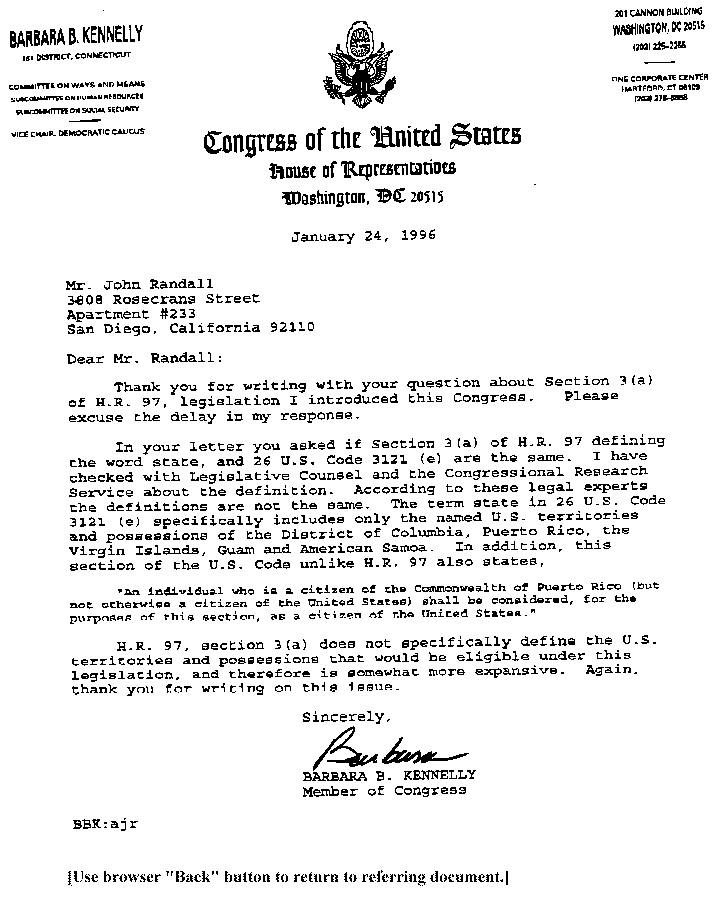
Soon after arriving
in Tucson, I was given a copy of a letter which Congresswoman Barbara Kennelly
had written to one John Randall in San Diego, California. If ever there was any one, single document
which proved that a major thesis of The Federal Zone is entirely correct,
beyond all doubt, this letter was
it. This one was good, and true.
Many who do
read Kennelly's letter are impressed by the fact that it was written on
Congressional stationery, and mailed under their franking privileges. Government by appearances is a better term
for this behavior.
The real story is that Kennelly did not know the correct answer to Randall's
question, so she went to the "experts" for advice, and merely relayed
their answers back to Randall. Career
specialists in federal law, in two different government offices ‑‑
the Legislative Counsel and the Congressional Research Service –- all agreed
that the term "State" in the IRC includes only the named territories and possessions of the District of
Columbia, Puerto Rico, the Virgin Islands, Guam, and American Samoa.
When the dust
had settled in the grand jury case, this author prepared a Press Release to
publicize Kennelly's earth-shaking and revealing admission. That Press Release now follows, verbatim:
FOR IMMEDIATE RELEASE August 28, 1996
Congresswoman Suspected of Income Tax
Evasion
Payson, Arizona.
Paul Mitchell, a Counselor at Law and Citizen of Arizona state, today
challenged U.S. Representative Barbara Kennelly to stop evading the big
question about federal income taxes:
Does the term "State" at Internal Revenue Code 3121(e) include
only the named federal territories
and possessions of the District of Columbia, Puerto Rico, the Virgin Islands,
Guam and American Samoa? Can this be income
tax evasion? Read on.
In a letter
to Mr. John Randall of San Diego last January 24, Kennelly responded to a
written request from Randall asking her if the word "State" in 26
U.S. Code 3121(e) and in other pending legislation were the same. Rep. Kennelly, a Democrat from Connecticut,
first checked with the Legislative Counsel and with the Congressional Research
Service about the definition.
"According to these legal experts," answered Kennelly, "the
definitions are not the same. The term
state in 26 U.S. Code 3121 (e) specifically includes only the named U.S.
territories and possessions." Her
letter to Randall, on official House of Representatives stationery, was dated
January 24, 1996.
This
admission is earth-shaking, according to Paul Mitchell, who has conducted an
in-depth investigation of federal laws and the U.S. Constitution for seven
years now. If the Internal Revenue Code
was deliberately written to confuse the American people into believing that "State"
means "Arizona" or "California," when it does not, then the
Congress has a lot of explaining to do.
Mitchell has since challenged Kennelly to produce copies of the
correspondence she received from the Legislative Counsel and Congressional
Research Service, but she has now fallen silent and refuses to answer any
follow-up letters. Congress,
incidentally, exempted themselves from the disclosure requirements of the
Freedom of Information Act.
Writing under
several pen names, Paul Mitchell's work has reached all the way into the U.S.
Supreme Court, which adopted "the federal zone" as a household word
in their sweeping 1995 decision in U.S. v. Lopez. His book entitled The Federal Zone: Cracking the Code of Internal Revenue, was first published in 1992, and became an
instant underground success for its lucid language and indisputable legal
authority. The book was originally
written in electronic form, which made it easy to disseminate through the
Internet. The fourth edition can be
viewed with the Alta Vista search engine, developed by Digital Equipment
Corporation. The Internet version does
not preserve any bold, underline,
or italics, however. Mitchell has used special character formats
to highlight important words and phrases in federal statutes and case laws,
easing the reader's burden of deciphering an otherwise unintelligible code.
It is clear,
there is a huge difference between the area covered by the federal zone, and
the area covered by the 50 States.
"Money is a powerful motivation for all of us," writes
Mitchell in a chapter from the book.
"Congress had literally trillions of dollars to gain by convincing
most Americans they were inside its
revenue base when, in fact, most Americans were outside its revenue base, and remain outside even today. This is deception on a grand scale, and the
proof of this deception is found in the statute itself." Indeed, the proof is now leaking out on
official Congressional stationery.
Mitchell goes
on to argue, it is no wonder why public relations "officials" of the
IRS cringe in fear when dedicated
Patriots admit, out loud and in person, that they have read the law. It is quite stunning how the carefully
crafted definitions of "United States" do appear to unlock a statute
that is horribly complex and deliberately so.
As fate would have it, these carefully crafted definitions also expose
perhaps the greatest fiscal fraud that has ever been perpetrated upon any
people at any time in the history of the world.
It is now time for a shift in the wind.
That shift is being driven by a growing understanding of personal status
and its relation to government territorial jurisdiction.
The vivid
pattern that has now painfully emerged is that "citizens of the United
States", as defined in federal tax law, are the intended victims of a
modern statutory slavery that was predicted by the infamous Hazard Circular
soon after the Civil War began. This
circular admitted that chattel slavery was doomed, so the bankers needed to
invent a new kind of slaves. These "statutory" slaves are now
burdened with a bogus federal debt which is spiralling
out of control. The White House budget
office recently invented a new kind of "generational accounting" so
as to project a tax load of seventy-one percent on future generations of
these "citizens of the United States". The final version of that report upped the
projection to eighty percent.
"It is our duty to ensure that this statutory slavery is soon gone
with the wind, just like its grisly and ill‑fated predecessor,"
concludes Paul Mitchell.
#
# #
What follows
here is the exact text of Kennelly's letter.
Pay particular attention to the precise language found in the second
paragraph:
The
term state in 26 U.S. Code 3121(e) specifically includes only the named U.S.
territories and possessions of the District of Columbia, Puerto Rico, the
Virgin Islands, Guam and American Samoa.
[bold
emphasis added]
This level of language precision is quite rare, coming
as it did from a lawmaker currently seated in the U.S. House of
Representatives, in Washington, D.C. More
importantly, Kennelly is telling us that experts in the offices of the
Congressional Research Service, and the Legislative Counsel, agree completely with the main, and highly
controversial thesis of this book:
Congress of the
United States
House of Representatives
Washington, D.C.
20515
January 24, 1996
Mr. John Randall
3808 Rosecrans Street
Apartment #233
San Diego, California 92110
Dear Mr. Randall:
Thank
you for writing with your question about Section 3(a)
of H.R. 97, legislation I introduced this Congress. Please
excuse the delay in my response.
In your
letter you asked if Section 3(a) of H.R. 97 defining
the word state, and 26 U.S. Code 3121 (e) are the
same. I have
checked with Legislative Counsel and the Congressional
Research
Service about the definition. According to these legal experts
the definitions are not the same. The
term state in 26 U.S. Code
3121 (e)
specifically includes only the named U.S. territories
and possessions
of the District of Columbia, Puerto Rico, the
Virgin Islands,
Guam and American Samoa. In addition, this
section of the U.S. Code unlike H.R. 97 also states,
"An
individual who is a citizen of the Commonwealth of Puerto Rico (but
not otherwise a citizen
of the United States) shall be considered, for the
purposes of this
section, as a citizen of the United States."
H.R.
97, section 3(a) does not specifically define the U.S.
territories and possessions that would be eligible under
this
legislation, and therefore is somewhat more
expansive. Again,
thank you for writing on this issue.
Sincerely,
/s/ Barbara
BARBARA B. KENNELLY
Member of Congress
BBK:ajr
[bold
emphasis added]
Finally, it
was no surprise when Rep. Kennelly refused to answer my polite request for
copies of any written communications which she had received from those two
offices. Remember, silence had become
their custom in that zone. Their fraud
is so enormous and far-reaching, they really do have no choice in the matter,
but to fall totally and completely silent.
Here's that letter:
MEMO
TO: Rep.
Barbara B. Kennelly
Member
of Congress
FROM: Paul Andrew,
Mitchell, B.A., M.S.
Counselor
at Law
DATE: June
28, 1996
SUBJECT: Definition
of "State" in IRC 3121(e)
I am a
part-time student of comparative economic history, and your letter to Mr. John
Randall of San Diego, dated January 24, 1996, just happened across my desk
recently (see attached).
I would be
very interested to obtain copies of any written communications you received
from the Legislative Counsel and the Congressional Research Service concerning
the definition of the term "State" as found in 26 U.S. Code, Section
3121(e).
Would it be
possible for you to send me copies of their written communications to you, if
any?
These
communications would be very helpful to certain aspects of my current research
endeavors, in particular, the fallout from a set of U.S. Supreme Court
decisions known as The Insular Cases (circa 1900).
Rep.
Kennelly, thank you very much for your consideration.
Sincerely yours,
/s/ Paul Andrew Mitchell
Paul Andrew Mitchell, B.A., M.S.
Counselor at Law, Federal Witness,
and Private Attorney General
email: supremelawfirm@yahoo.com
attachment: letter to John Randall,
January
24, 1996
copies:
Legislative Counsel
Congressional Research Service
Reader's Notes: